
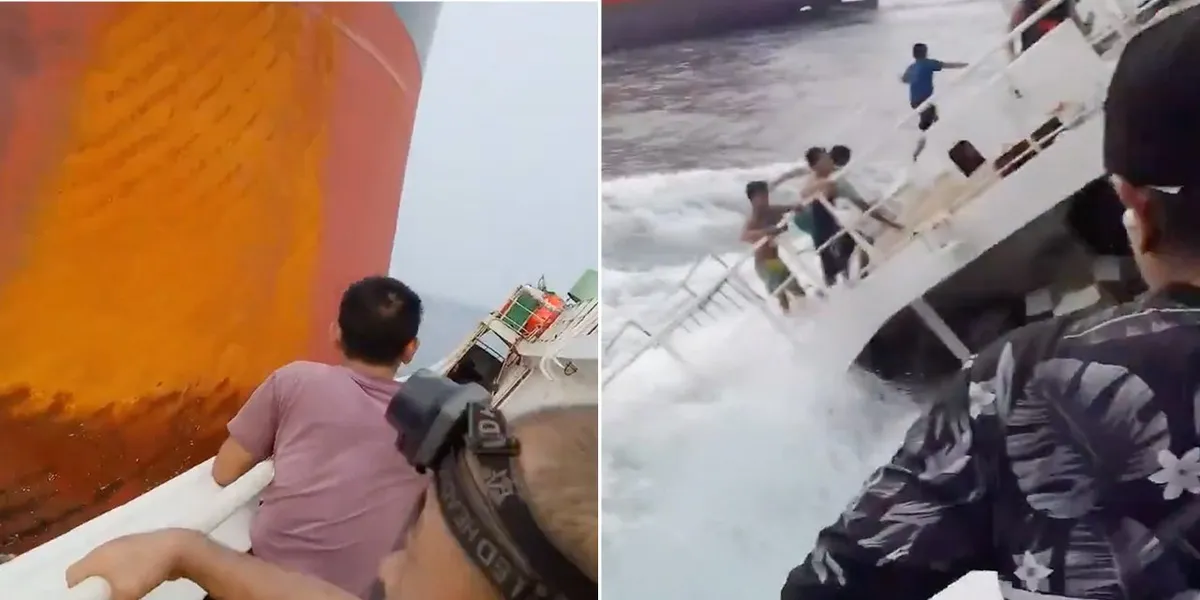
Horrifying footage has captured the moment a 229-metre Panama-flagged bulk carrier, First Margaux, ploughed into the Chinese fishing vessel Luqing Yuanyu 108 in the Singapore Strait.
The incident, filmed from aboard the 49-metre trawler on Thursday 17 September, saw the cargo ship closing in from behind before striking the smaller boat’s starboard side.
Terrified crew members can be seen desperately gripping railings as the impact tilts the fishing vessel sharply, sending large volumes of seawater flooding across the deck. Shouting is audible throughout.
No injuries or fatalities have been reported. Singapore’s Maritime and Port Authority has not yet issued a public statement on the collision.
Both vessels had departed from anchorages in the Singapore area at approximately the same time that morning.
First Margaux, a Japanese-owned and Chinese-managed bulk carrier capable of hauling around 82,000 tonnes of cargo, left a busy anchorage on Singapore’s eastern side and headed west.
The Luqing Yuanyu 108 set off from an anchorage close to Sentosa, steering southward.
The two ships entered the same westbound lane of the traffic separation scheme, a routing system overseen by the International Maritime Organisation to manage vessel movements through the congested strait.

A crew on board a Chinese fishing vessel were left terrified after being crashed into by a huge Panama-flagged cargo ship
|
X
According to The Maritime Executive’s reconstruction using tracking data, the bulk carrier was overtaking the fishing boat at the point of contact, travelling up to three knots faster when its bow struck the smaller vessel.
Sal Mercogliano, a maritime historian and professor at Campbell University, offered his analysis of the incident on social media.
He noted that a third bulk carrier, Gas Iris, had been entering the shipping lane from First Margaux’s right-hand side, potentially boxing the cargo ship in and leaving the fishing vessel trapped between two far larger ships.
Mr Mercogliano stressed that “one of the problems of ship collision videos is you only get one perspective”, emphasising that the Singapore Strait “is one of the most complicated and busy traffic areas on the planet”.

Smoke could be seen rising from the vessels following the collision
|
X
Mr Mercogliano observed that First Margaux had been positioned in the correct traffic separation scheme lane.
He suggested that a slight turn to port might have averted the collision, but a mandatory starboard turn towards Singapore lay just ahead.
Ship-tracking data indicates the Luqing Yuanyu 108 remained afloat after the collision, with its automatic identification system continuing to broadcast.
The Maritime Executive reported that the fishing vessel subsequently made it to a nearby berth.

The crash caused water to pour into the ship and throw the crew members around the vessel
|
X
First Margaux, meanwhile, maintained a westbound course at roughly 10 knots for about two hours before halting, turning around and dropping anchor.
The three-year-old bulk carrier holds a clean inspection record.
Panama’s maritime authority has confirmed it is now investigating the incident.
The Singapore and Malacca straits together constitute one of the most vital shipping corridors on earth, handling close to 40 per cent of worldwide trade and approximately a third of all seaborne oil, making the waterway the globe’s busiest route for crude and petroleum products by volume.


Leave a Reply