
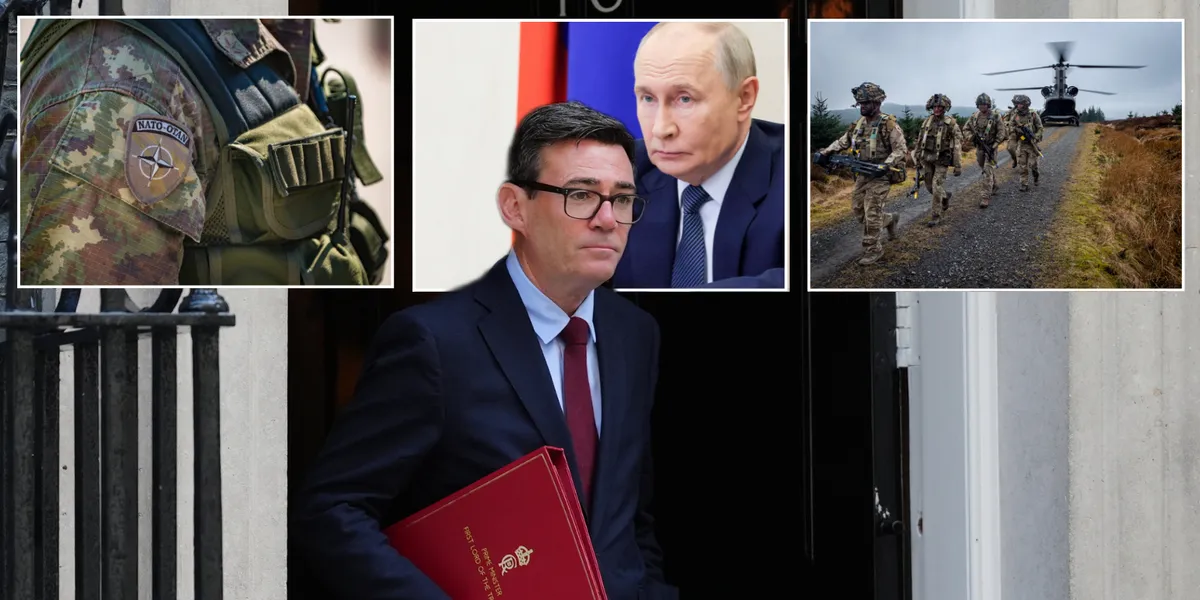
Andy Burnham has been told to establish an emergency register of civilian volunteers in case Britain comes under attack.
The Liberal Democrats called for a UK network to be “more direct” with the public about the dangers facing the UK.
“Countries like Finland and others already have these kind of registers out there, and I think it’s something a lot of people would be very willing to sign up to if we gave them the option,” a Liberal Democrat spokesman said.
Britons would be given a formal way to help if Britain came under attack, with preparations being made for any potential crisis.
The British Army has been reduced to its smallest size since before the Napoleonic wars in the 19th century.
The Liberal Democrats have also put pressure on the Prime Minister to introduce a new position of Civilian Readiness Secretary, arguing non-military resources must be built up ahead of a crisis.
This comes as a new public information drive is expected from the Government, which will encourage people to prepare for extreme weather, cyber attacks and hostile state action.
The national resilience campaign aims to highlight practical steps people can take to stay safe during a crisis that could disrupt power or water supplies or force shops to close.

The Government is expected to announce a new public information drive to prepare the public for a potential national crisis
|
PA
A source told the Financial Times: “There will be practical advice on things you can do to improve domestic resilience, like having some bottled water and tinned food. It will be common sense, not scaremongering.”
Mr Burnham is coming under increasing pressure to raise defence spending.
The Prime Minister has so far refused to set a date for spending three per cent of GDP on defence, despite his own Chancellor John Healey resigning as Defence Secretary over the issue under Sir Keir Starmer.
Mr Healey wrote in a letter to Sir Keir in June: “You have been unable, and the Treasury has been unwilling, to commit the resources that the nation needs to defend the country at this time of rising threats.”

Putin has ramped up acts of sabotage against European nations since the start of this year
|
GETTY
The Government has pledged to meet a longer-term ambition, the Nato defence spending target of 3.5 per cent of GDP by 2023.
Britain is also facing increased threats from Russia, with Europe falling victim to a series of Kremlin-backed acts of sabotage.
Poland, Latvia, Estonia, Romania and Lithuania have all experienced airspace violations from Russian drones, with Germany last month accusing President Putin of a failed attack on one of its airports.
European leaders fear President Putin is planning to ramp up his operations in Ukraine, with the possibility of drafting around 300,000 troops.
There are also fears Russia will carry out attacks on infrastructure, such as undersea pipelines, power grids and communication hardware.
Britain foiled a secret Russian military plot to disable “critical” undersea cables earlier this year.
Nato allies caught Russian submarines working on a secret weapon designed to disable vital undersea cable infrastructure near the Svalbard archipelago, which belongs to Norway.
Western intelligence analysts are becoming increasingly anxious that Russia might test the strength of the alliance’s mutual defence agreement – Article 5 of Nato.
One warned a potential attack could come in “months, not years”.
The warnings follow Poland’s Prime Minister Donald Tusk, who told his Parliament intelligence assessments suggested Russia may target a Nato territory with drones or missiles in the coming months, in an effort to demonstrate “Article 5 is more theoretical than practical”.
French President Emmanuel Macron described Mr Tusk’s warnings as “sound and well documented”.
On Friday, he convened an emergency meeting in Paris with party leaders and 2027 presidential candidates, in which the growing threat of Russia was discussed.
The UN General Assembly is preparing to convene in New York later this week, against a backdrop of intensifying airstrikes on both sides of the war in Ukraine.

Leave a Reply