
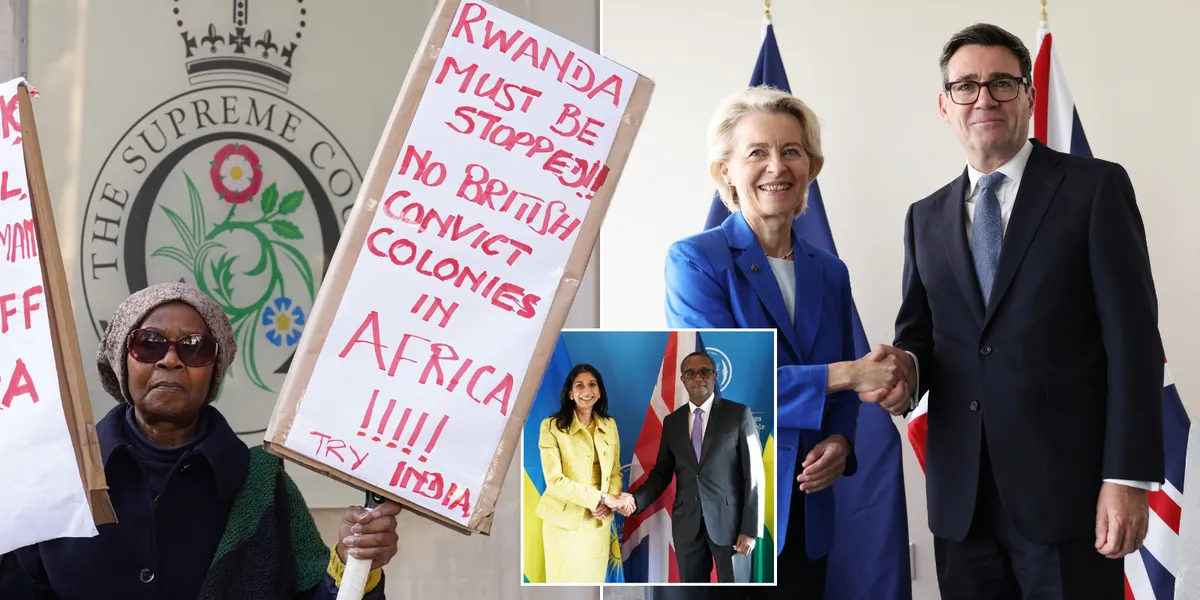
The European Union has been accused of hypocrisy after member states began pursuing plans for deportation centres outside the bloc, despite previously condemning Britain’s Rwanda scheme as “extreme”.
The latest developments have been highlighted by the Facts4EU think-tank, working with Stand for Our Sovereignty and The Campaign for an Independent Britain, which argue that the EU is undergoing a major shift in its approach to migration.
The research claims European governments are increasingly considering policies resembling the approach adopted by the UK’s former Conservative government, which sought to send some asylum seekers to Rwanda for processing.
Britain’s policy was fiercely criticised by European officials and campaigners, who raised concerns over its legality and treatment of asylum seekers.
Now, several European capitals are exploring the use of third countries to process or receive migrants whose asylum claims have failed.
A coalition involving Denmark, Germany, Austria, Greece and the Netherlands has emerged as a key force behind the proposals.
Known as the “Copenhagen Five”, the countries are seeking to establish operational third-country deportation centres outside European soil by the end of 2027.
Danish Immigration Minister Morten Bødskov said: “We have agreed on concrete steps towards a deal with a non-European Union country on return facilities.

Critics say the EU is ‘copying the UK’s homework on mass immigration’ in a move of ‘great hypocrisy’
|
GETTY
“Our expectation is to be ready to send rejected asylum seekers to deportation centres located outside the European Union by the end of 2027.”
Rwanda and Uganda are reportedly among the countries being considered for potential arrangements.
The developments coincide with the implementation of the EU’s New Pact on Migration and Asylum, which came into force on June 12.
European Commission President Ursula von der Leyen has also adopted tougher language on border enforcement.

The Tories proposed using Rwanda as a third country for deportations
|
GETTY
In her State of the Union speech, she said: “Europe’s commitment to its values and fundamental rights remains, but there will be no compromise on border protection, as Europeans determine who enters the union and under what conditions, not smugglers and traffickers.”
Meanwhile, EU Commissioner for Migration Magnus Brunner said during the launch of the new system: “On 12 June we will not be cutting the ribbon. We will be launching the operational system.
“We are putting our European house in order. This creates the conditions for us to decide who can come to Europe, who can stay, and who must leave.”
However, the tougher approach has exposed deep divisions between EU member states.
Under the bloc’s mandatory “solidarity” system, countries that refuse to participate in the relocation of migrants from frontline states such as Greece and Italy can face a financial contribution of €20,000 (£17,200) per migrant.
Poland and Hungary have opposed the arrangements, while the Netherlands has sought an opt-out from EU migration rules, according to the Facts4EU analysis.
Former UK Secretary of State Lord Redwood said: “The EU is deeply divided on migration, with countries under democratic pressure over weak borders pressing for a Rwanda style solution.
“They want offshore processing of asylum claims and somewhere to deport illegals.

European Commission President Ursula von der Leyen has also adopted tougher language on border enforcement
|
GETTY
“If Brussels continues to block solutions or insist on complex rules that make them impractical, the populists will sweep to power in more countries.
“If Brussels hides behind their human rights laws, favouring the rights of migrants over the concerns of citizens, they will badly misjudge the mood in Europe.
“More populist governments will take control of their own borders in the absence of EU control.
“They will refuse to pay the fines Brussels is imposing if they do not take enough of the migrants the EU lets in.
“The UK voted for Brexit in part to take control of our borders. When will the government use the freedoms it has to do so?”
The proposed European system differs in legal and practical respects from Britain’s former Rwanda policy and EU institutions continue to insist that migration controls must comply with fundamental rights and European and international law.
The debate is nevertheless likely to intensify pressure on Brussels, as member states grapple with competing demands for stronger border controls, national sovereignty and common EU rules.


Leave a Reply