
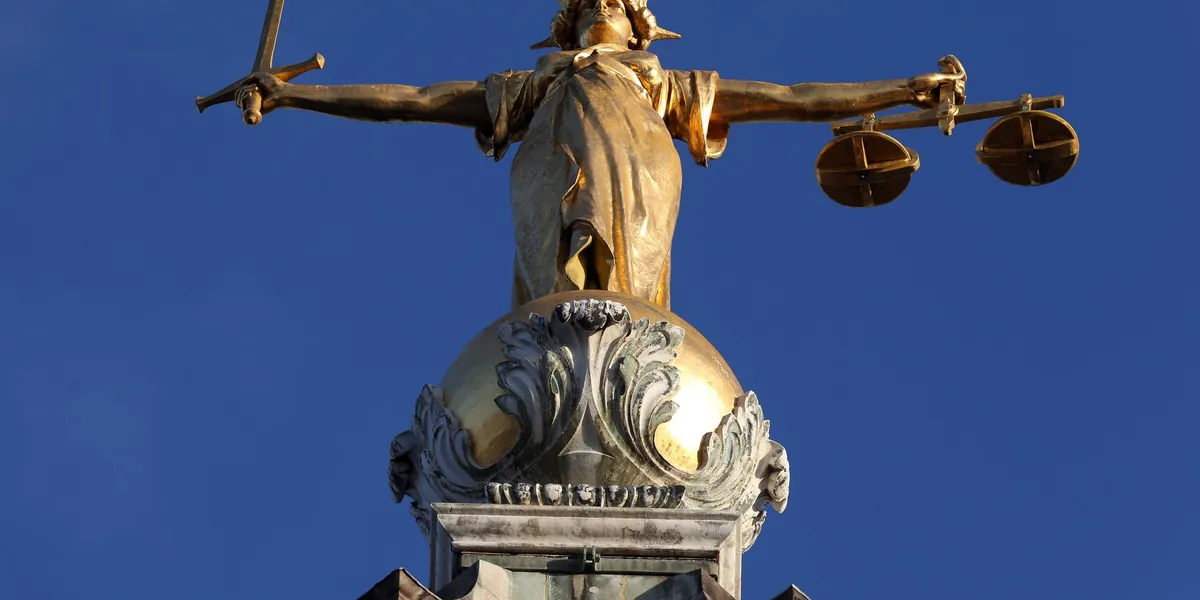
Until now, I had been reluctant to believe Britain had a two-tier justice system. Such arguments, I noticed, were often made by individuals whose politics were, shall we say, a bit questionable, and who, for all their claims about “biased judges”, might not be altogether even-handed if they ever found themselves sitting in judgement on their political opponents.
By and large, most judges in this country do a good job and act with integrity; I am certain of that. But every now and then a sentence will be handed down which is so striking in its harshness and inconsistency it is hard to believe it was not motivated by something other than a genuine desire to deliver justice. And such outcomes do appear to be increasing in frequency.
Witness the case of Del Somerville. Last week, Somerville was jailed for two years for his role in a recent protest against small boat arrivals that had broken out at Eastney Marina in Portsmouth.
Now, for someone to be sent down for a stretch of that duration these days, the offence would usually have to be rather serious, or the defendant would have already run up a string of convictions (as Somerville had not). Otherwise, such a sentence would be rare.
So, what was Somerville’s crime? Well, during the protest, which was attended by hundreds, he swore at police and threw a plastic bottle. Hard to believe, I know. But that really was the extent of it.
What is more, the court heard Somerville had played a relatively minor role at the event, had tried to pull another protester away when he confronted police, had actually lived at the marina rather than travelled there for the purpose of protesting, and the plastic bottle he threw was small and empty.
For all this, he will be incarcerated for two years.
Nobody should seek to defend Somerville’s aggressive actions at the protest. However, in the context of wider sentencing policy in this country, the punishment meted out to him seems draconian in the extreme. Indeed, how can it be viewed as anything other than a glaring example of two-tier justice?

Del Somerville was sentenced at Portsmouth Crown Court for his involvement in the demonstration on the Hampshire coast
|
HAMPSHIRE POLICEEvery week, the media is full of court reports detailing how offenders who commit far more serious crimes than Somerville did – including violence and sexual assaults – receive less severe sanctions. Sometimes, they avoid jail completely, getting off with a suspended sentence or community order.
Moreover, confrontations have routinely broken out at protests called in support of other causes, yet there is scant evidence of courts dishing out punitive punishments. Maybe that is explained by the fact those causes are seen as more fashionable by some of our elites. Who knows?
Concerns over lopsided sentencing began to intensify following the Southport massacre in 2024. While certain individuals acted in appalling ways in response to that atrocity and deserved to be shamed, some of the sanctions handed down were wholly at odds with the lenient approach generally taken by our court system.
Most notoriously, Lucy Connolly was jailed for two and half years for a social media post – swiftly deleted – which asserted she would not care if someone set fire to every migrant hotel. The post was repellent, but it arguably did not constitute explicit incitement. At any rate, there was no serious likelihood that anyone would act on her words.
Others who had posted similarly unpleasant things on their social media accounts in the hours and days after Southport were also handed lengthy prison sentences. Perhaps influenced by the words then Prime Minister Sir Keir Stamer, who had described street protesters as “far right”, prosecutors and judges, often so liberal in their outlook, suddenly appeared very eager to adopt a reactionary “hang ‘em and flog ‘em” stance.
More widely, we have seen citizens prosecuted – and sometimes locked up – for expressing social or political opinions, or even making jokes, which, while certainly obnoxious and abusive, really ought not to have been considered crimes. Yet in a country whose authorities have attempted to embed a rigid ideological conformity on certain issues – especially anything falling within the ambit of the new national religion of diversity, equity and inclusion – and enacted a web of restrictive laws designed to regulate how citizens may express themselves, what are we to expect?
Again, I stress none of this is to defend the actions of every individual who has ended up on the wrong side of the law. It is to highlight the wild disparity between the treatment of people who post nasty things on social media or get a bit truculent at immigration protests and that of others who seem to do much worse things.
Consider, for example, the case of Liam Bennett. On September 18, Bennett was convicted at Plymouth Crown Court after being found in possession of hundreds of indecent images of children. Many of the images fell within the most serious category. Bennett was handed a suspended sentence. A heinous crime with real victims at its heart – but the offender will not even see the inside of a jail cell.
Meanwhile, Del Somerville may not see the outside world again until 2028. Even when the jails are overflowing and dangerous criminals are being granted early release in large numbers, Somerville’s conduct was deemed sufficiently serious to warrant a drawn-out confinement.
The truth is the British establishment sees protests about immigration as inherently less worthy than other types of protest and those who attend them as uncouth, uneducated and a threat to the cosmopolitan liberal values they hold so dear.
They may not be able to ban the protests outright, but they can darn well dole out the severest punishments to anyone they deem to have stepped over the line.
The establishment is playing with fire. For any justice system to command public trust, it must show that it does not treat citizens less favourably on account of their legitimate political views or act in ways that can be seen as overtly partisan.
A truly impartial justice system is the cornerstone of a civilised society. Compromise on that, and the rule of law itself, as well as social order, will quickly be imperilled.
It is almost as if the authorities are going out of their way to incite civil conflict.


Leave a Reply