
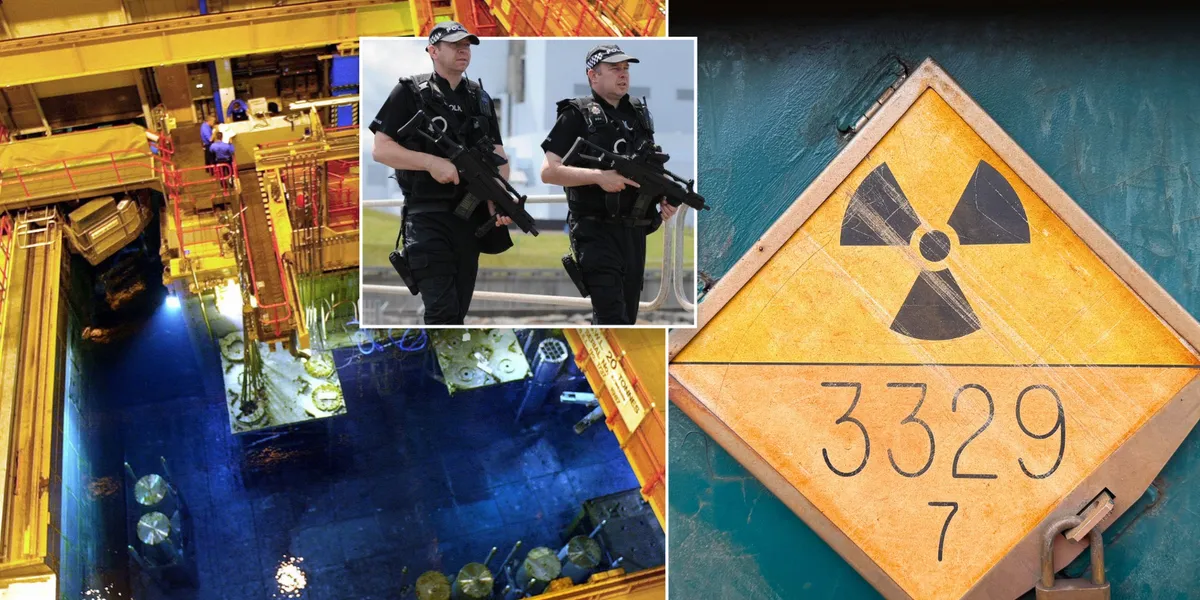
Fears have been raised over a “dirty bomb” in Britain after it emerged armed guards could be pulled from certain nuclear waste shipments to cut costs.
Britain’s Nuclear Decommissioning Authority (NDA) is proposing the cuts in a bid to save millions of pounds.
Radioactive material from enriched uranium to lower-grade items like contaminated clothing is routinely moved across the country by specialist trains, vehicles and ships.
The most hazardous cargo currently travels with armed escorts from the Civil Nuclear Constabulary.
But the NDA now wants to scale back mandatory armed protection, claiming the curent set-up can be excessive.
The plans have raised alarm among security experts as concerns mount over Russia’s escalating “hybrid warfare” operations against British critical infrastructure.
Though nuclear industry leaders insist the changes carry no risk and could free up significant funds for a Treasury under pressure ahead of Andy Burnham’s first Budget.
The proposals centre on plutonium and enriched uranium – highly sensitive materials that could endanger public health or, in the worst case, be fashioned into a “dirty bomb” using conventional explosives.
So-called dirty bombs mix traditional explosives with radioactive material to contaminate a small area.

The most hazardous cargo currently travels with armed escorts from the Civil Nuclear Constabulary (pictured)
|
CIVIL NUCLEAR CONSTABULARY
Matt Okuhara, who served with the CNC from 2006 to 2012, told The i Paper: “I think it’s a bad idea, it really is. The reason you’ve got to guard this stuff in the first place is because of how dangerous it is.
“Anyone who gets hold of this material can use it for anything they want, they can use it for a dirty bomb, they can use it for a poisoning device. That’s why you need to have a strong deterrence force around the material in transit.”
In May, GCHQ director Anne Keast-Butler warned that Russia was “scaling up its daily hybrid activity against the UK and Europe, stretching from the seabed to cyberspace.”
She said Russia was “relentlessly targeting critical infrastructure, democratic processes, supply chains and public trust.”
While earlier this year, hackers linked to the Iranian regime shut down a British power plant for four days in an unprecedented attack.
BRITAIN’S INFRASTRUCTURE UNDER THREAT – READ MORE:

PICTURED: Radioactive waste is cooled at the Sellafield nuclear processing site
|
GETTY
The proposals appear in a 57-page document backed by six nuclear industry chief executives, including those running Sellafield and Nuclear Transport Solutions, the state-owned firm that handles material movements.
The report was drawn up after former Chancellor Rachel Reeves demanded savings across the sector after a review last year.
According to the document, the changes could reduce the cost of certain shipments by 10 to 20 per cent and eliminate weeks of security planning.
Nuclear Transport Solutions says the proposals would allow it to “reduce cost and complexity of transport whilst maintaining robust safety and security outcomes and avoiding being priced out of the market.”
Industry leaders also argue the current threat assessment framework was built for fixed nuclear sites and is “unrealistic against a maritime setting.”
They say this leads to security measures that are “impractical or disproportionate” for transport operations.

Britain needs a ‘strong deterrence force around the material in transit’, Matt Okuhara said
|
GETTY
Rob Jordan, director of proliferation and nuclear policy at the Royal United Services Institute, said the threat of “hybrid” or “grey-zone” warfare from Russia and other hostile states is “particularly high.”
“Damaging a truck on a nuclear convoy, or even blocking the route of a convoy causing serious delay, could cause embarrassment to the Government rather than it causing any kind of significant risk,” Mr Jordan said.
“But we shouldn’t underestimate Russia’s desire to destabilise through embarrassment, through a sense of the British government’s inability to do things properly.”
A CNC spokesman said: “The risk to our civil nuclear sector and to our wider critical national infrastructure is at the highest it has been for many years. We will match our protection to that threat.”
The NDA said any changes would be made in collaboration with the Government and regulators without compromising safety or security.


Leave a Reply