
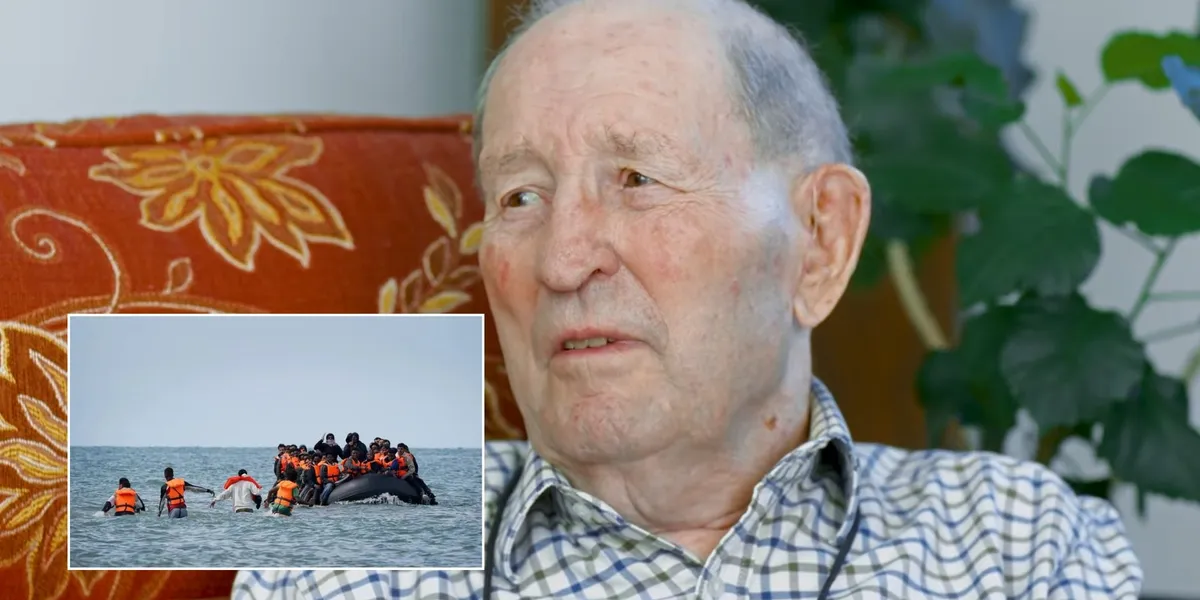
A Falklands war veteran has received backlash after saying he would “shoot” the dinghies smuggling illegal migrants across the English Channel.
Major-General Julian Thompson, 92, is a former commander of 3 Commando Brigade who led British ground forces during the Falklands War.
His military record is formidable. Enlisting in the Royal Marines in 1952, he served for over three decades and authored numerous works on military history following his retirement.
He commanded the ground element of Operation Sutton – the assault at San Carlos Water in May 1982 – the landings that became pivotal in recapturing the Falkland Islands.
But he has caused an online stir following his provocative statements regarding the ongoing migrant crisis in the Channel.
“I would shoot them,” Maj Gen Thompson declared in a documentary on mass immigration produced by journalist Steven Edginton for his YouTube channel, broadcast this weekend.
The retired Royal Marine, spoke bluntly about the thousands of migrants reaching British shores each month.
“We could stop them tomorrow if we really had the guts. I’d shoot them, sorry, but I would,” he said.

His remarks drew swift condemnation from both the Home Office and the Shadow Home Secretary.
When contacted regarding his remarks, Maj Gen Thompson offered a clarification: the gunfire ought to be directed at the boats themselves rather than those aboard them.
Far from retreating from his stance, the veteran commander showed no concern about any potential backlash, telling the Mail on Sunday: “As long as they don’t come around here, I don’t mind what they do.”
He added: “They come over here and rape our girls. One machine-gun blast is all it would take… then they would get the message. I just want them to bugger off.”
LATEST ON THE MIGRANT CRISIS
- Hundreds of migrants dead after boat collapses in ‘devastating loss of life’
- Labour urged to tell GB News the truth after ‘covering up’ asylum seeker rape guide cost to taxpayers
- Reform vows to slap tariffs on countries that refuse to take back migrants as party promises to deport Afghan and Palestinian refugees

“If they [the Government] don’t stop them, then there will be a revolution. Our leaders are just wet.”
In the same documentary, Maj Gen Thompson expressed a deeply pessimistic view of the nation’s trajectory.
“It’s not Britain any more, it’s a sort of funny conglomeration of people, and in a wet country that allows itself to be pushed around all over the place,” he remarked, adding: “I’m glad I won’t see it, I’ll be dead.”
He also took aim at the Islamic faith held by many of those making the crossing, describing it as “a flawed religion, in that women are totally out. They can be treated like chattels, and children the same.”
Shadow Home Secretary Chris Philp was unequivocal in his response: “Opening fire on migrant boats would be completely wrong. I understand people’s anger at migrant crossings but we cannot shoot at people. There is another way to end this.”
Mr Philp argued that if France refuses to intercept vessels close to shore, Britain should remove every illegal arrival from the country within seven days of their landing.
Achieving this, he maintained, would require withdrawal from the European Convention on Human Rights – a step included in the Conservative Party’s borders strategy but one he accused the Labour Government of being too feeble to take.
“Instead of being deported on arrival, illegal immigrants get put up in hotels and flats. This has to end,” he said.

A Home Office spokesman responded firmly, stating: “This Government is bearing down on dangerous and illegal crossings. Anyone who seeks to take the law into their own hands is putting lives at risk and will face serious criminal consequences.”
The latest figures on Channel crossings paint a mixed picture. Over 20,000 migrants have reached Britain by small boat so far in 2026, representing a 40 per cent reduction compared with the equivalent period last year.
A staggering 1,739 people made the 21-mile journey to reach British borders between October 1 and October 7 – equivalent to one every six minutes.
Yet the danger of each individual crossing appears to have intensified.
The average number of people crammed aboard each vessel so far this month has increased to 76, bringing this year’s total of crossings to 20,935.
Our Standards: The GB News Editorial Charter

Leave a Reply