
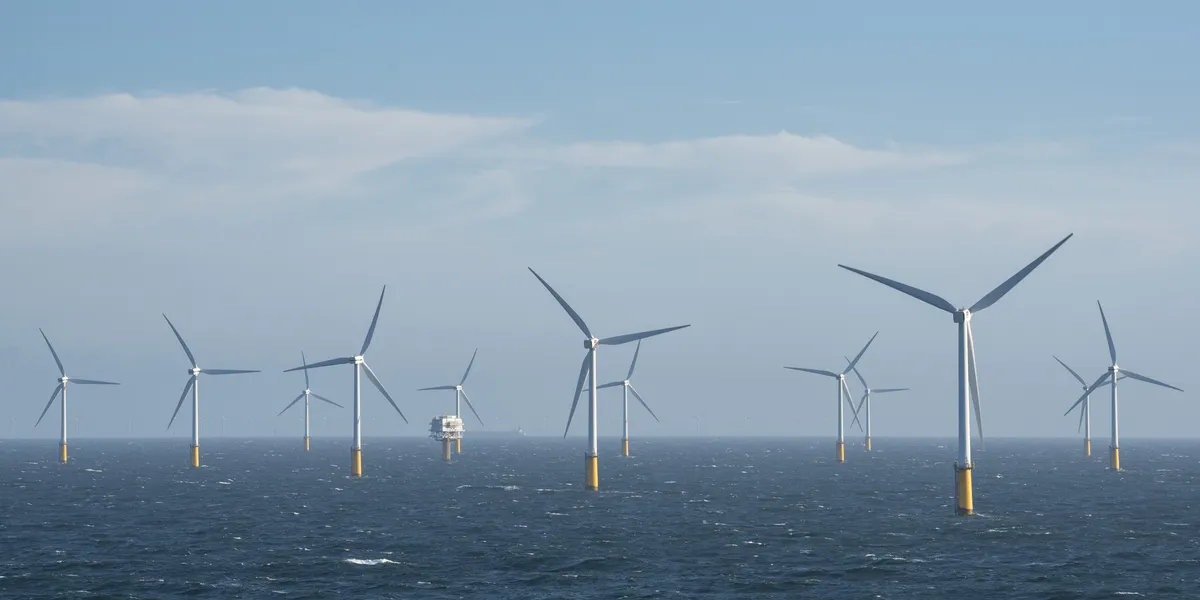
Britain has spent more than £1.5billion this year paying wind farms to switch off and gas plants to step in, figures show.
On one day in September the bill topped £1 million every hour, according to Octopus Energy.
The figures mean the country has already passed last year’s total costs of £1.47 billion with three months still to go.
Octopus Energy founder Greg Jackson said the current system was “madness”.
The costs arise when remote wind farms are paid to switch off because the grid cannot cope with the power.
Expensive gas-fired plants that are nearer demand are then paid to turn on.
Octopus Energy said September alone saw £404.3million paid in wind-related constraint costs.
On September 30, £30million was paid to wind and gas generators, or more than £1million an hour.

Octopus Energy founder Greg Jackson said the current system was ‘madness’
|
GB NEWS
It said September includes seven of the most expensive days ever recorded since its affiliated Wasted Wind tracker came online in 2018.
The costs are passed onto consumers via energy bills.
The original grid was built to handle energy from traditional power stations, which were frequently situated near the coalfields that fuelled them.
But, with renewables, the source of power is often more remote, meaning greater connectivity is required to move it to where it is required.
Billions are being spent on upgrading the grid, but generation capacity has been built faster than the grid has expanded.
This has led to energy bottlenecks and temporary upgrade work has made these even worse, Octopus said.
The bulk of the costs come from replacement gas. Wholesale costs have soared because of the Iran war and geopolitical uncertainty, pushing the price up even higher.
Grid operator Neso forecasts that constraint costs could hit £3.2billion in the year to July 2027, and, by 2030, Government estimates put the figure as high as £10billion.
Neso has said the answer is to improve the grid so that less energy is wasted.
Mr Jackson, also the CEO of Octopus, has called for changes to the wholesale pricing system.
He is a supporter of zonal pricing, where bills reflect where power is being generated and where it is needed.
Electricity prices are currently set on a national wholesale market.
With zonal pricing, electricity costs vary depending on region.
Mr Jackson says this system would give businesses and residents local to generators cheaper energy, rather than simply wasting the power.
Analysis by FTI, commissioned by Octopus Energy, suggested =such a system would cut bills across Britain, with a typical household saving up to £114 a year.
Mr Jackson said: “We’ve already blown past last year’s entire bill, and customers are paying every pound of that waste. It’s madness.
“We’re spending billions to build more grid, while failing to use our existing infrastructure more efficiently.
“Instead of paying to throw away homegrown cheap power, we should be using it to bring bills down for households and businesses.”
The Government ruled out a move to zonal pricing last year, opting for other reforms to the energy market.
A spokesman for the Department for Energy Security and Net Zero said upgrading the grid would open the door to cheaper energy.
Work was underway to speed up the process.
The spokesman said: “Britain’s outdated grid is holding the country back.
“New wind farms, solar projects and businesses are stuck waiting years for connections, keeping us reliant on global fossil fuels and driving up costs for households.
“That’s why we’re tackling decades of historic underinvestment by reforming the connections queue, launching Great British Grid to unlock billions of pounds of public and private investment, and ending the red tape that slows projects down by allowing developers to build their own connections.”


Leave a Reply