
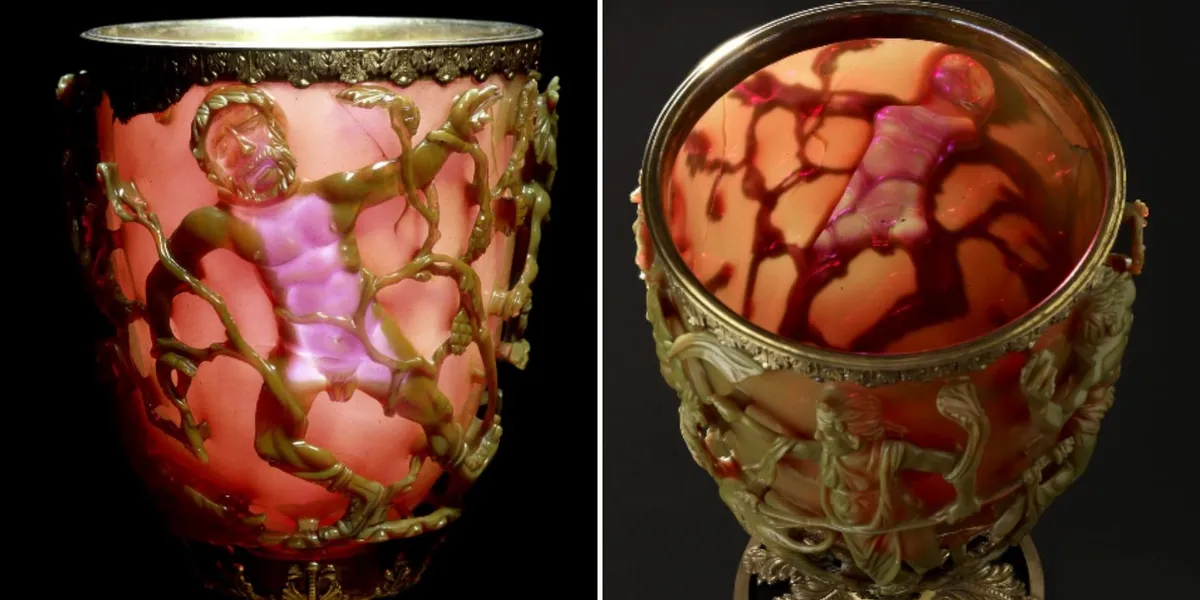
Researchers at the University of Sheffield have managed to recreate the extraordinary colour-shifting properties of the Lycurgus Cup, a 1,600-year-old Roman glass masterpiece housed in the British Museum.
The remarkable feat, which involved embedding tiny particles of gold and silver into glass, reproduces a so-called dichroic effect that has puzzled historians and glass-makers alike for centuries.
The cup transforms from jade green under standard lighting to a deep ruby red when illuminated from behind, with Dr Lisa Hollands, a technician in Sheffield’s School of Chemical, Materials and Biological Engineering, describing it as “magic”,
She told The Guardian the project was “a labour of love”, noting that “people have tried it before with limited success”.
The breakthrough was achieved using an ancient recipe analysed from a fragment of the Roman original.
Dating from the fourth century, the original piece features an intricate mythological scene carved in deep relief. It depicts the god of wine, Dionysus, triumphing over King Lycurgus, a figure drawn from the sixth book of Homer’s Iliad, shown being dragged down by vines.
The remarkable colour shift – technically known as a dichroic effect – occurs because of the way light interacts with the glass depending on its direction.
When viewed in reflected light, the surface appears an opaque green; when a source is placed behind it, the cup glows a vivid red.


This astonishing piece of optical engineering has bemused experts for generations, with an international panel recognising the cup in 2022 as one of the seven glass wonders of the world.
Making matters more fascinating, a letter attributed to the emperor Hadrian, addressed to his brother-in-law, references “parti-coloured cups that change colour” intended for use “at banquets on feast days”.
Dr Hollands conducted the initial research alongside Prof Caroline Jackson, one of the foremost authorities on Roman glass.
The central challenge lay in embedding nanoparticles of gold and silver – each roughly a thousand times smaller than a single grain of sand – into the glass itself.
LATEST SCIENCE NEWS
- Sir David Attenborough’s new BBC documentary makes surprising discovery about dolphins
- Scientists crack quantum mystery that has puzzled researchers for decades
- Britons set for stunning night as rare supermoon dazzles stargazers across the UK


The team produced a thick molten glass and, as it cooled from temperatures exceeding 1,000°C, gold and silver nanocrystals began forming around particles within the material.
Explaining the science, Dr Hollands told the newspaper: “White light is made up of many different colours and you see this when there is a rainbow in the sky.
“Nanoparticles are much smaller than the wavelengths of light and in certain conditions they block certain colours due to the light affecting the electrons in the atoms.”
When light passes through the glass, the metallic particles filter out blue and green wavelengths, permitting only reds and oranges to transmit. Light striking the surface, by contrast, is scattered by the particles, producing the opaque green appearance.
Ian Freestone, emeritus professor of archaeological materials at University College London, said the Sheffield project represents a marked advance on earlier efforts.
Although a glass with comparable colouring was produced in the 1960s, he noted that this latest work far more closely matches the actual green and red hues of the original cup.
“This is more ambitious and more precise,” he said. “I was excited because, for the first time, I was getting a feel of just how difficult it was to get these colours. This will help us understand how the Roman craftsmen actually worked.”
Prof Freestone also pointed to a theory that the red-green shift may have symbolised grapes ripening, given the vine imagery in the carved scene. “So it could have been used in a drinking ceremony of some sort,” he said.
To bring the replicated glass to life as a work of art, the university commissioned glass artist Elliot Walker to create a contemporary sculpture.
The sculpture will be revealed at Sheffield’s Millennium Gallery as part of the university’s Festival of the Mind, running from November 6 to 15. It will subsequently go on permanent display at the Turner Museum of Glass.
Dr Hollands, reflecting on the gulf between ancient and modern expertise, said: “If the Romans could have seen me experimenting, they’d probably laugh and ask: ‘Why does she not know how to make this?’”
Our Standards: The GB News Editorial Charter


Leave a Reply