
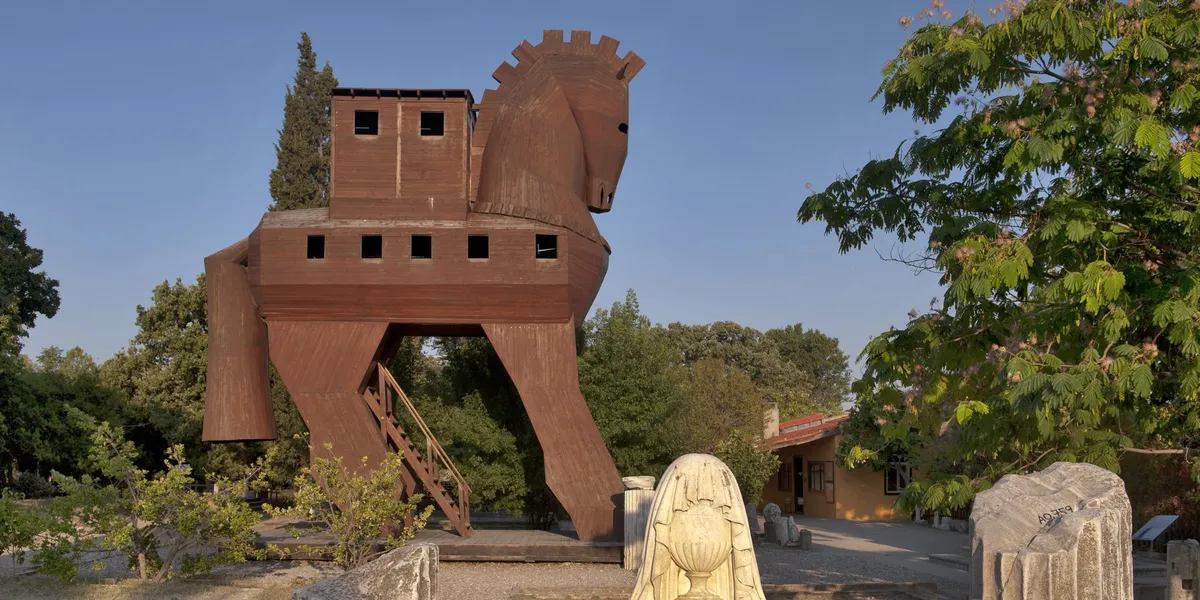
An ancient market dating back 2,800 years has been discovered at Troy, with archaeologists uncovering what happened to the city after the end of the Trojan War.
Archaeologists working at the legendary site have unearthed what is believed to be the city’s oldest public gathering space.
The agora was discovered during ongoing excavations on Hisarlik hill in north-western Turkey, conducted jointly by the Turkish Ministry of Culture and Tourism and Çanakkale Onsekiz Mart University.
The find, revealed earlier this week, upends the long-accepted view that Troy was left deserted for several hundred years following its destruction by the Greeks, traditionally placed at 1184 BC.

Archaeologists working at Troy have unearthed what is believed to be the city’s oldest public gathering space
|
GETTY
Scholars had previously maintained that the site remained uninhabited until Aeolian Greeks settled there during the eighth century BC, establishing the city they called Ilion.
The dig programme, which began in 2014, builds on more than 150 years of archaeological inquiry at the site.
German archaeologist Heinrich Schliemann first broke ground there around 1870, guided by Homer’s epic poems, and established a chronological framework spanning nine distinct phases, from Troy I through to Troy IX.
The area now under scrutiny corresponds to a public space linked to Troy VI, roughly 1700–1300 BC, widely considered the settlement’s zenith before the famous conflict.
Troy was inscribed on the Unesco World Heritage list in 1998.
Interest in the ancient city has grown further with the release of Christopher Nolan’s film The Odyssey earlier this year.
Beyond the agora itself, the team also uncovered a paved road connecting to the settlement’s southern gate, along with ceramics from the Iron Age.
These artefacts collectively undermine the prevailing narrative of a prolonged abandonment.

German archaeologist Heinrich Schliemann first discovered Troy around 1870
|
GETTY
Reyhan Körpe, deputy director of the excavation, explained that newcomers arrived a mere 80 to 90 years after Troy’s downfall, repurposing the ancient walls as foundations for their own dwellings.
Rather than centuries of silence, the evidence now points to a relatively swift reoccupation — a timeline that fundamentally reshapes understanding of what happened at one of antiquity’s most storied locations.


Leave a Reply