
A new undersea storage site for greenhouse gas proves that Net Zero shouldn’t mean shutting factories, industrialist Sir Jim Ratcliffe has said.
The Greensand facility, hailed as “a new front in the existential fight against climate change”, was opened this morning by King Frederik X of Denmark.
Europe’s first commercial storage site will allow millions of tonnes of the gas, captured from industrial plants, to be injected a mile beneath the seabed rather than released into the atmosphere.
It demonstrates that carbon storage is a “practical reality”, EU officials said. Carbon capture and storage (CCS) is set to play a crucial role in fighting climate change, because many industries, including cement and chemicals, are almost impossible to decarbonise fully.
Without ways of catching and storing emissions, affected sectors could have to scale down production in order to hit Net Zero targets.
This has been labelled “decarbonisation by deindustrialisation”.
But Sir Jim, whose INEOS Energy led the Greensand project, insisted: “Europe will not achieve Net Zero by closing factories and exporting its jobs.”
Sir Jim, who is also a part-owner of Manchester United, said work on capturing industrial carbon now needed “to scale across Europe”.

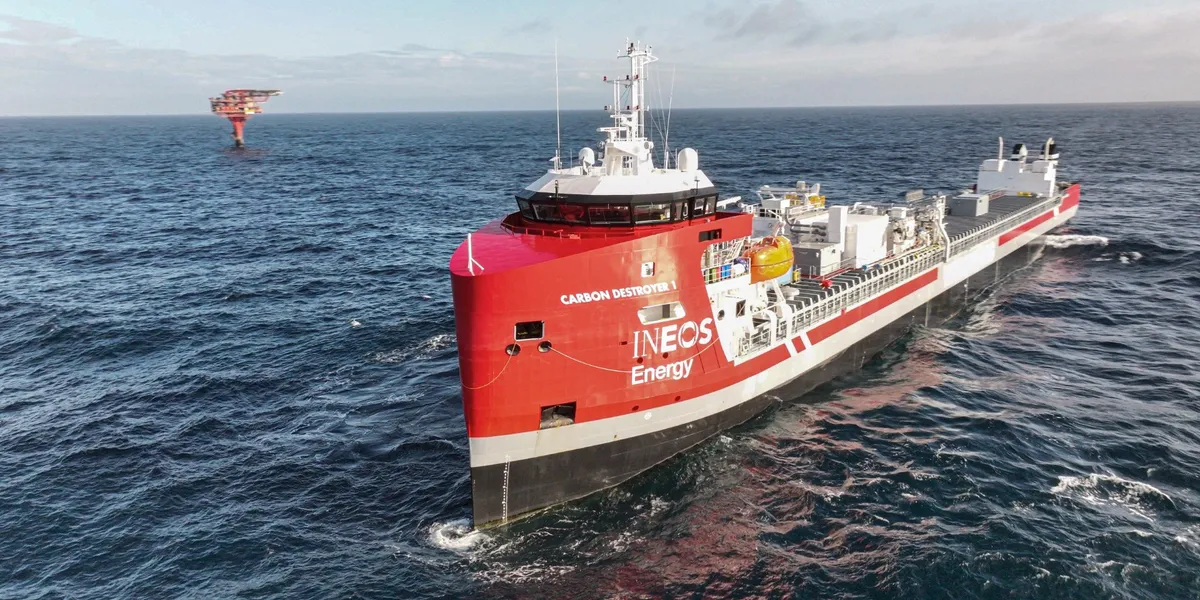
Carbon Destroyer 1, a purpose build ship for transporting waste carbon dioxide
|
INEOS
He said: “Government needs to work hand in hand with industry to allow industry to remain competitive while reducing emissions. Greensand proves it can be done.
“This is not a pilot project, a concept or a political ambition. It is a fully operational carbon storage business.
“The technology works. The storage is ready.
“The challenge now is creating the right conditions for carbon capture to scale across Europe.”
INEOS said that decarbonisation was too frequently framed as a choice between industrial competitiveness and climate progress.
“Greensand shows that is a false choice,” the company said.
Greensand expects to store up to 400,000 tonnes of CO2 annually in its first commercial phase. This is due to be scaled up toward a potential of up to eight million tonnes at full capacity.
The EU aims to capture and store a total of 50 million tonnes of CO2 by 2030. Around 450 million tonnes will need to be captured by 2050 to achieve climate neutrality, or Net Zero.

A choice between industrial competitiveness and climate progress is ‘false’, INEOS said
|
INEOS
CO2 destined for Greensand will be sourced mainly from Danish biomethane plants. Once captured, it is liquefied and delivered to a dedicated CO2 terminal at Port Esbjerg on the Danish coast.
It is then shipped aboard Carbon Destroyer 1 – the EU’s first purpose-built CO2 carrier – and injected into the Nini West reservoir, a depleted oil field a mile beneath the seabed and 150 miles offshore.
European Commissioner for Energy and Housing Dan Jørgensen said: “Today marks an important milestone for Europe.
“With the launch, here in Esbjerg, of the first fully operational site for offshore carbon storage in the European Union, we prove that carbon storage is a practical reality.
“We show that we can move from demonstration to deployment. We set out a path for European industries: to continue their transition to a low-carbon future, while maintaining production, investments, and employment in our continent.
“And we open a new front in the existential fight against climate change.”
Mads Gade, CEO of INEOS Energy Europe, said the implications went far beyond the initial shipments.
He said: “We are ready to expand capacity to receive CO2 from industries across Europe. Greensand is open for business, and a new European market for permanent CO2 storage can now begin to take shape.”
David Bucknall, CEO of INEOS Energy, says: “For years, CCS in Europe has been defined by plans, targets and ambitions.
“Today, Greensand brings the EU’s first full-scale CO2 storage site and value chain into operation. It provides a foundation on which future Carbon Capture projects across Europe can now build.”
Europe’s energy-intensive industries directly employ almost eight million people and generate roughly €550billion (£472billion) in value added every year.
But high energy costs and tight climate regulations mean, like Britain, that its heavy industry is facing growing pressure from international competition.
The Federation of German Industries and Confederation of Danish Industry welcomed today’s opening in Denmark, saying in a joint statement that reaching Net Zero depended upon “maintaining a strong industrial base while reducing emissions”.
It said that carbon capture and storage was not just a climate policy tool but “also a strategic industrial policy instrument that enables Europe to retain production, protect jobs, strengthen resilience and avoid carbon leakage”.
CCS is also set to play a part its part in the UK’s route to Net Zero.
Plans include HyNet, which will take captured CO2 from sectors including cement and transport it to depleted gas fields beneath Liverpool Bay.
It aims to begin operating in 2028.

Leave a Reply