
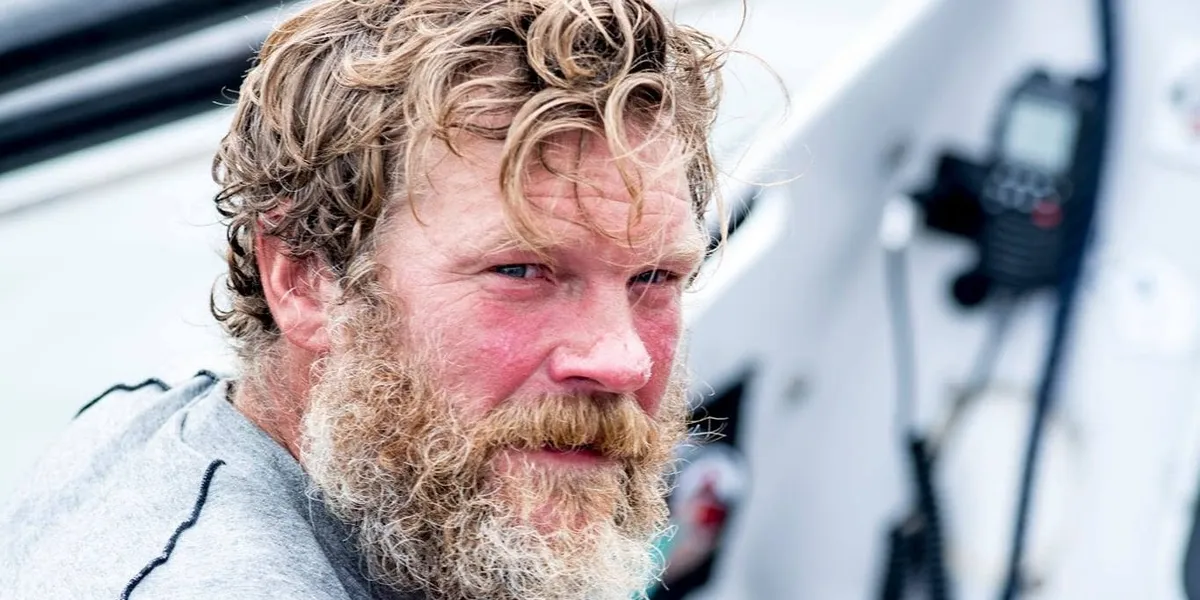
A Devon man with two decades of service in the Royal Marines is approaching the final stretch of an extraordinary oceanic feat that has already consumed more than 300 days of his life. Dave “Dinger” Bell, 54, departed from Lima in Peru on November 9 last year and now finds himself 900 nautical miles from the Kenyan port of Mombasa, where he expects to arrive in early October.
Should he succeed, Mr Bell will become the first individual to complete an unsupported rowing journey connecting South America with Africa. The expedition has taken him across both the Pacific and Indian Oceans in what experts have characterised as a “superhuman” undertaking.
Bell has rowed the distance without accepting physical assistance or setting foot on land throughout the voyage, which covers approximately 17,500 miles.
The scale of Bell’s endeavour becomes clear through the numbers: his journey spans 15,500 nautical miles in total, supported entirely by the 750 kilograms of provisions he loaded before departure. Upon completion, his achievement would dwarf the existing benchmark of 6,140 nautical miles established by American rower Jacob Adoram in 2019, according to the Ocean Rowing Society.
Yet the expedition’s conclusion remains uncertain. Georgie Vintner, Mr Bell’s partner who assisted with planning the voyage, warned adverse ocean currents pose “a risk” of dragging him towards Somalia instead of his intended destination.
“Things are not over till you place your foot ashore,” she told The Times. “He absolutely doesn’t need to be going to Somalia. If he gets to Kenya, I’ll be there on the beach ready to throw my crazy boyfriend a bar of soap.”
The expedition serves as a fundraising effort for Rock2Recovery, a veterans charity for which Mr Bell has already collected more than £36,000. Having completed 20 years in the Royal Marines, he expressed from his 8.3-metre carbon-fibre boat “Billy No Mates” he felt “humbled and grateful” to have emerged from service in good health and wished to contribute to those less fortunate.
“Two close friends of mine have been killed, colleagues have lost limbs and are suffering mentally,” he said.

Dave ‘Dinger’ Bell departed from Lima in Peru on November 9 last year
|
HANDOUT
However, Bell acknowledged that philanthropy represents only part of his drive. “But I’ll be brutally honest, I’m motivated by the grind of the challenge itself, the discomfort and the sense of achievement you get by going out on such a limb, the risk of failure.”
The voyage’s opening proved emotionally challenging, with Mr Bell describing watching his partner disappear from view as the most “gut-wrenching” moment of the entire expedition.
“I can distinctly remember the last time Georgie looked over her shoulder and looked away from me. It crucified me,” he said. “In the first few weeks, I really struggled with the pointlessness of what I was doing. I knew what I was doing was selfish. It would be silly to argue otherwise.”
Following his initial doubts, Mr Bell settled into rowing 12 hours daily towards Australia, a stretch of 7,500 nautical miles. Human interaction has been minimal throughout, with his closest encounter occurring in the Coral Sea, where a Chinese fishing crew expressed surprise when he refused their food offerings to preserve his unsupported status.
May brought the hazardous Coral Sea crossing, followed by passage through the Torres Strait, notorious for saltwater crocodiles. Flooding compromised his electrical systems whilst his waterlogged mattress caused salt sores requiring antibiotic treatment.
After covering 2,000 nautical miles along northern Australia’s coastline during June, Mr Bell departed the continent in early July. A subsequent 100-day push across 5,000 nautical miles brought him near Mauritius, his originally planned finish line, but upon reaching a position north of the island he opted to continue an additional 1,000 nautical miles to Mombasa, transforming the voyage into a genuine continent-to-continent crossing.
Fiann Paul, who serves as president of the Ocean Rowing Society, described the feat as among the most remarkable human-powered ocean expeditions ever attempted. “To cross the Pacific and then successfully continue across the Indian Ocean alone and unsupported, in one continuous expedition, is something I would describe as superhuman,” he said.
Paul noted Mr Bell chose a more challenging route than alternatives that would have offered favourable winds and currents via Cape Horn and the South Atlantic. The voyage’s unprecedented scale overwhelmed the society’s monitoring systems, which were designed for single ocean crossings.
“It’s like the millennium bug,” Mr Paul said. “The system was designed without seriously expecting that particular boundary to ever be crossed. Take it as a compliment to his pioneering.”
This marks Mr Bell’s second major rowing achievement, having previously completed an unsupported 119-day Atlantic crossing from New York to Newlyn in Cornwall during 2021. Guinness World Records has expressed hope Mr Bell will submit an application for potential record recognition.


Leave a Reply